AI Model Comparisons
AI Context Window Comparison 2026: Which Model Handles the Longest Documents?
6 min
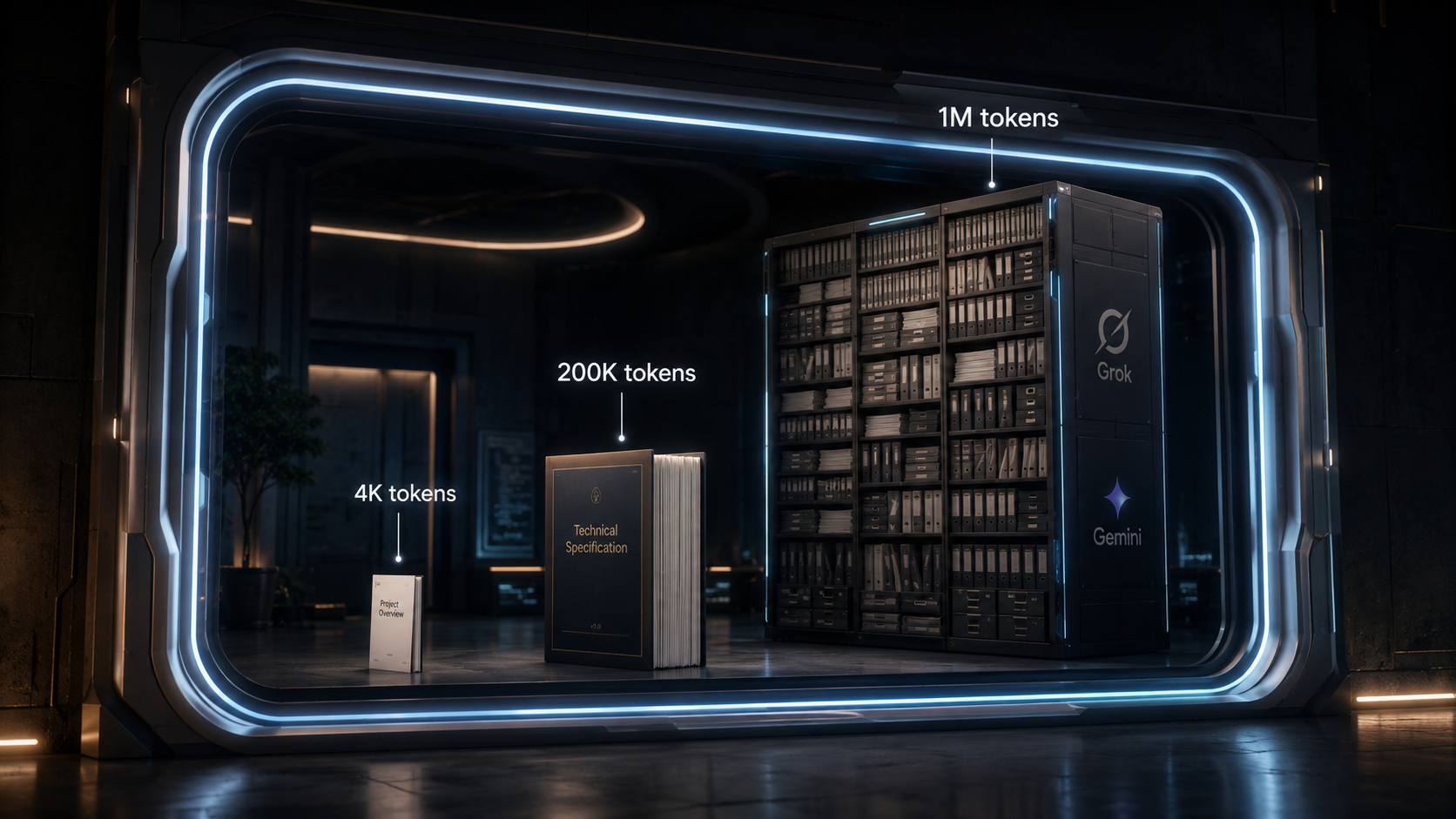
The largest context window among major AI models in 2026 belongs to Grok 4.3, Gemini 3.1 Pro, and Gemini 3.5 Flash, all at 1 million tokens. Claude Opus 4.8 offers 200K tokens. GPT-5.5 offers 128K. The difference matters for specific workloads — processing entire codebases, analyzing long research documents, or working with large datasets — but for most conversational and writing tasks, even 128K is more than enough.
Current context windows
| Model | Context Window | Notes | |---|---|---| | Gemini 3.1 Pro | 1M tokens | ~750,000 words | | Gemini 3.5 Flash | 1M tokens | Fast + 1M context | | Grok 4.3 | 1M tokens | Always-on reasoning | | Claude Opus 4.8 | 200K tokens | ~150,000 words | | Claude Sonnet 4.6 | 200K tokens | Same as Opus | | GPT-5.5 | 128K tokens | ~96,000 words | | DeepSeek V4 | 1M tokens | Open-source | | Mistral Large 3 | 128K tokens | EU-hosted option |
What these numbers actually mean
128K tokens (~96,000 words): a full novel, a large codebase, multiple lengthy PDF reports. More than enough for most professional workflows.
200K tokens (~150,000 words): extended context for very long documents or large conversation histories. Still not unlimited, but rarely a constraint in practice.
1M tokens (~750,000 words): entire codebases, lengthy legal document collections, multi-hour meeting transcripts, large datasets. This starts to matter for specialized use cases.
Most people don't actually need more than 128K for day-to-day work. Where the larger windows matter is at the extremes: processing entire GitHub repositories, analyzing hundreds of pages of legal or financial documents at once, or running models on full business document archives.
Context window vs. context quality
A large context window is not the same as a model that uses long context well. Models can have 1M token windows and still degrade in quality toward the end of very long inputs — this is called "lost in the middle" degradation.
Gemini 3.1 Pro has some of the best long-context retention among models with large windows. It was specifically engineered for large-document reasoning. Grok 4.3's 1M context is newer and has been tested less extensively at the extreme end.
Claude's 200K window has consistently strong performance across the full context length — the model tends to maintain quality and relevance even near the limit.
GPT-5.5's 128K window is well-optimized but smaller. For tasks near or above that limit, you'll need chunking strategies or a different model.
When context window actually matters
Where it matters a lot:
- Processing an entire codebase to understand architecture or refactor broadly
- Feeding a model a full legal case file or lengthy contract for analysis
- Running analysis on a complete research paper collection
- Long multi-turn conversations that accumulate significant history
Where it matters less:
- Most writing and editing tasks (documents are rarely over 50K words)
- Standard Q&A and chat
- Coding assistance on specific files or functions
- Research synthesis from external sources (Perplexity handles this live)
Practical recommendation
If context window is your primary constraint, Gemini 3.1 Pro at $19.99/month (or via API at ~$3.50/$10.50 per million tokens) is the best option — 1M tokens, frontier-quality reasoning, and the lowest price among the 1M-window models at the consumer tier.
If 200K tokens is sufficient and you care more about reasoning quality, Claude Opus 4.8 or Sonnet 4.6 on Claude Pro ($20/month) is a strong choice.
GPT-5.5's 128K covers most use cases. If you're regularly hitting the limit, consider whether the documents you're processing could be chunked more intelligently, or whether switching to a larger-context model makes more sense than working around the limit.